



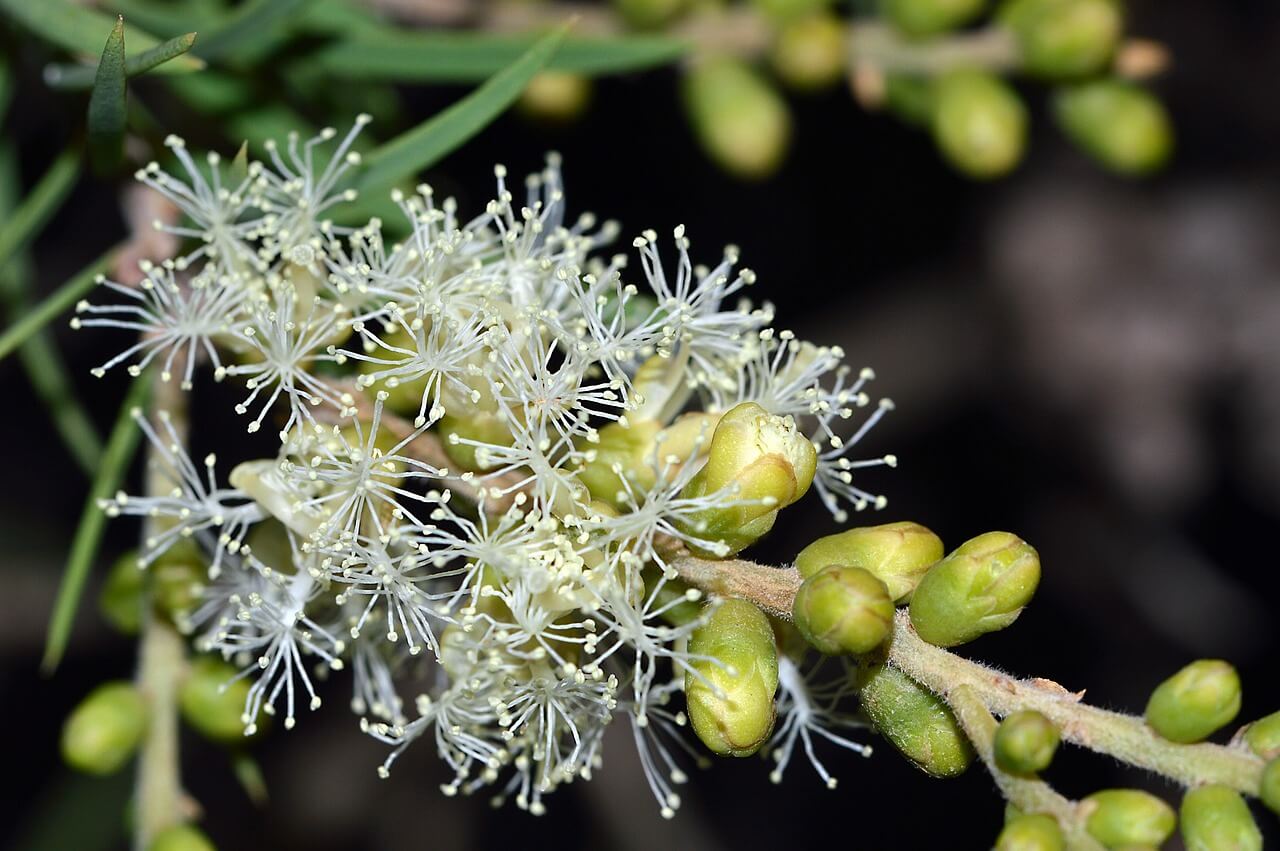
 From the leaves of Melaleuca alternifolia, a plant native to Australia also called Tea Tree, an essential oil is extracted and used for its antimicrobial properties. This essence is a mixture of many chemicals, called terpenes, among them terpinen-4-ol (contained at least 30%), cineole, gamma-terpinene, p-cymene, alpha-terpinene and others.
Terpinen-4-olo, the most interesting principle, is contained in Thyme essential oil, nutmeg and other extracts. Scientists are studying it because, actually, it seems to show antimicrobial effects: it kills efficiently meticillin-resistant Staphylococcus aureus too, its action increasing when isolated from other components of essential oil. Scientists are analyzing its tumor inhibition ability too: it seems to be antiproliferative against two murine cancer strains and able to induce apoptosis (a particular mechanism of cellular death) in human leukemic cells. These data are encouraging, but yet not definitive; moreover, they are interesting as they are included in scientific studies aimed to create drugs to be used under medical supervision, certainly not for self-medication. Why?
We must not forget that Nature is fascinating, that it is our “host” to be respected for a happy coexistence; but we must beware side effects, quite common in natural substances. About terpinen-4-ol, there are 2 concerning issues:
- it is bioaccumulable, that is once it is absorbed it remains into lipidic tissues and into breast milk;
- it is suspected to be an endocrine disruptor, as they verified its tendency to mimic hormones with oestrogenic and antiandrogenic activity.
The latter was first supposed, when physicians found hormone diseases in prepubertal children (aged from 4 to 10), who were using body cleansers containing Tea Tree oil, as well as lavender essential oil; just stopping their use, hormone problems desappeared. Endocrine cells disruption – by both Tea Tree oil and lavender oil independently of each other – were then studied in depth and verified in laboratory.
In conclusion: if the scientific community, after further studies, will decide to use this chemical for treating certain diseases, certainly it will take into account drawbacks too for the assessment of the cost-benefit ratio. In our opinion, terpinen-4-ol (and Tea Tree oil too) must be managed with caution; above all, it is not suitable to be used as an ingredient for cosmetics or detergency.
This is the reason why Bensos products, either detergents, Benè body cleansers or Benè creams, do not contain it.
References: Khaw-on P et al, Asian Pac J Cancer Prev 13(7): 3073-76 (2012); Toxnet – HSDB; Miyazawa M et al, J Agric Food Chem 49(9): 4312-4 (2001); Cal K et al, J Dermatol Sci 41(2): 137-42 (2005); Greay SJ et al, Cancer Chemother Pharmacol 65(5): 877-88 (2010); Loughlin R et al, Lett Appl Microbiol 46(4): 428-33 (2008); D. V. Henley et al., N Engl J Med 356:479-85 (2007).




Leave a Reply